
Mark Twain tears into the Mississippi river like, I don’t know, a serial dater relative telling you about her latest guy over the potato salad at a Labor Day family picnic. Both presume a healthy skepticism and rush to their subject’s defense. Both take strength in the superlative. Twain begins Life on the Mississippi like this—
The Mississippi is well worth reading about.
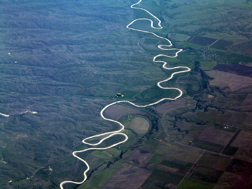
—just in case you’re feeling a little queasy about the 414 pages and four Appendices. By the end of page one he’s proudly pronounced her the longest, crookedest, most expectation-defying river in the world. And so fertile! He dispatches the St. Lawrence, the Rhine, and the Thames with their inferior water discharge. And he starts in on perhaps his most beloved observation—for don’t we all love to find ourselves reflected back—the mighty stream’s great eccentricity. Doesn’t it narrow and deepen at its mouth when the other tired conformists do just the opposite?
And there begins page two.
If you’re standing on a riverbank south of Baton Rouge, Twain tells us, the mud deposit of the Mississippi likely created that land. And it can just as easy take it away by eroding its alluvial banks at will and charging off in any direction it pleases. It makes and breaks towns this way—lively port towns can become sleepy country ones when the river deserts—and can change your state of residence overnight. In this way it could have rendered a Missouri slave a free inhabitant of Illinois.
One begins to feel a little enthusiasm. And then Twain, reminding us that the first white man, De Soto, first glimpsed the stream in 1542, goes for broke:
Unquestionably the discovery of the Mississippi is a datable fact which considerably mellows and modifies the shiny newness of our country, and gives her a most respectable outside-aspect of rustiness and antiquity.
Take that, Europe! And then, like the cousin breathlessly contemplating how he can still be single, Twain takes aim at over a century’s worth of crap explorers who, though they were crawling, robbing, and enslaving all over the place, didn’t think the river was worth a look. He sniffs
In our day we don’t allow a hundred and thirty years to elapse between glimpses of a marvel. (LM, 43)
In a recent post I alluded to Life on the Mississippi as a love letter of sorts, and I must say that now as I approach page 414 I have a clearer vision of why that would be: the trajectory of Twain’s affection resembles my own for a handful of people and things I’ve known. He does longing so brilliantly, and to this I can relate. But it gets complicated, of course, for he gets a lot closer than sixteenth century musings and the stoic statistics of the river’s drainage basin. And longing rarely—in my experience too, Mr. Twain—survives possession, or mastery.
He gets right behind the wheel, actually, apprenticed to the renowned steamboat and famously cool-headed pilot Horace Ezra Bixby in his early twenties. Twain’s love of the river stemmed from a vivid childhood obsession—he played pilot and first mate like other generations played cops and robbers—and he’s in his glory to be living out a dream.
Here I must quickly give a rudimentary description of a rudimentary science: the piloting of steamboats down the Mississippi in the mid-nineteenth century. There was no GPS, no buoys, no charts, no lights save the “flickering, smoky, pitch-dripping, ineffectual torch-baskets.” (LM, 176) There was just huge, frightfully expensive boats, an ever-changing river, an engine powered by boilers producing steam under enormous pressure, and an economical (and testosterone-driven?) need to reach the destination as fast as possible without, well, blowing up. And many did blow up. Twain’s beloved younger brother Henry died of injuries sustained in the explosion of the Pennsylvania.
Sometimes they tossed in a cargo load of highly flammable cotton.
 The pilots sat up high in the pilot house armed with a wheel, a speaking tube, some bells, a log book filled out by the previous watch, maybe a whistle. They rang the bells to signal the leadsmen down below to go to starboard or larboard (now called port) and take a sounding. This entailed lowering oneself half off the boat and dropping a lead line in the water to measure the depth, which was of vital interest since about 1,543,442 things (no exaggeration as Twain tells it) could conspire to change the depth or introduce a crisis and thus ground or sink the boat.
Leadsmen would report depth findings back by singing the mark—and they really did sing it. Mark One signaled six feet above the lead (lead-filled pipe attached to bottom of lead line), Mark Twain signaled twelve feet above the lead (Twain calls it two fathoms) and was a guarantee that the tub sat in safe water. The bells and speaking tube were used to communicate with the engine room and the engineers: they would reverse the wheel or alter the steam on command.
Regarding the origin of Sam Clemens’ pseudonym, it is a typical Twain mystery: he says he stole it upon the death of a grizzled old mariner from the ancient days of steamboat piloting, one Captain Isaiah Sellers, who wrote down purely practical information about the river and published it under the name Mark Twain. But, as footnote 50 in my Penguin Classic reports, there is “no absolute evidence” to prove or refute this claim, and the scholars are obviously nettled by this. The footnote sighs and shakes its head and sends us off to another text for the most in-depth exploration of “this whole difficult issue” (LM, 449).
Twain would object to my calling it a rudimentary science. He goes to great lengths in the first portion of the book to intimate just how exact a science it was: a science whose facts and principles and methods were lodged wholly in the prodigious brain—the memory—of the steamboat pilot. That organ had to house the Google Earth capture of the Mississippi before there was Google Earth. Twain is endlessly praising of it, and I can see why.
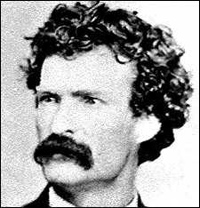
His own training in the river did not begin well. As I read the early chapters, of his arguments with Bixby, of the painful unfurling of the minute attentions the river would require, I was reminded . . . of a familiar cadence and sentiment from a beloved book from my own childhood. And since I’ve had mash-ups on the mind, I figured . . .
 |
 |
The below sticks quite close to the text, saving you, by my estimation, 23 5/8 pages of reading. You’re welcome or I’m sorry, I can’t really decide.
[Green indicates Horace Bixby speaking
Red indicates the leadsmen
Black is Samuel Clemens].
.
Learning* a River Cub
You’ll learn this river
By heart, you’ll see!
You’ll know this river
Like A, B, C.
Must I learn it upstream and down?
Of course you dash-dash-dashed clown!
Must I learn all brands of night?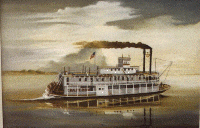
Pitch-black, gray mist, and yes, moonlight.
Must I learn it without buoy?
From New Orleans clear through St. Louis.
Each craggy stump and wet wood pile?
Only for the next twelve hundred miles.
Oh hellfire, blazes, and damnation!
I’ll chip a piece of that plantation!
You’ll get this river
By heart, you’ll see!
You’ll know this river
Like A, B, C.
 But I can’t remember in the fog
buried wrecks or Hanging Dog.
I can’t remember all the marks
caving banks or in the dark.
I can’t remember Madrid’s Bend
Jacket Pattern or fickle wend.
I can’t remember in a raft
in a yawl or fore-and-aft.
I can’t remember shapeless shore
I can’t remember one thing—
Half Twain! Half Twain!
Half Twain! Half Twain!
Look out now—
You’ll bash her brains!
I quit! A roustabout I’ll be!
I’ll kill the cub who quits on me.
Bluff reefs and sand bars and to think
I can’t even recall the ways to sink!
Would you, could you, had you notes?
Start writing or you’ll kill the boat!
That there is Six Mile Point, so look
and use your Memorandum book.
Oh wait—what’s that I see?
A friendly sight, that cottonwood tree!
I know him from our last trip down
And hell—I recognize this town!
I did it! I’ve got this river now.
(And you said I couldn’t pilot a cow.)
But somehow nothing seems as fine.
The romance is gone, new burden mine.
The water now a telling yarn
I read to keep the boat from harm.
Say farewell to beauty and grace
And fix an eye on the shoalest place.
*As Twain puts it, “‘Teach’ is not in the river vocabulary.” (LM, 90)
.
.
I quite like this passage about learning to read the water:
The face of the water, in time, became a wonderful book—a book that was a dead language to the uneducated passenger, but which told its mind to me without reserve, delivering its most cherished secrets as clearly as if it uttered them with a voice. . . . There never was so wonderful a book written by man; never one whose interest was so absorbing, so unflagging, so sparklingly renewed with ever re-perusal. The passenger who could not read it was charmed with a peculiar sort of faint dimple on its surface. . . but to the pilot that was an italicized passage . . . for it meant that a wreck or a rock was buried there that could tear the life out of the strongest vessel that ever floated. (LM, 94)
And reading the river did, in Twain’s estimation, rob it of romance:
Now when I had mastered the language of this water . . . I had made a valuable acquisition. But I had lost something, too. I had lost something which could never be restored to me while I lived. All the grace, the beauty, the poetry had gone out of the majestic river! (LM, 95)
But I said it gets complicated, and that’s because the book is an amalgam of diverse parts: there’s the river’s early history, then the text about his pilot days published years earlier in The Atlantic and called Old Times on the Mississippi, a segue in chapter 21 in which Twain explains away the intervening twenty-one years of his life (in half a page), and the last part captures his return to the river in April 1882 when he was forty-six years old. The last is by far the longest, and one senses that Twain has forgotten that romance exited the river when he was just twenty-three, for he drifts up and down its banks in his middlish age bidding it farewell all over again: lamenting loss and bygone days and change, and muttering doubt over the efficacy and wisdom of some of the endeavors that are meant to symbolize progress.
Mostly he misses his old friends:
Half a dozen sound-asleep steamboats where I used to see a solid mile of wide-awake ones! This was melancholy, this was woful. The absence of the pervading and jocund steamboatman from the billiard-saloon was explained. He was absent because he is no more. His occupation gone, his power has passed away, he is absorbed into the common herd, he grinds at the mill, a shorn Samson and inconspicuous. Half a dozen lifeless steamboats, a mile of empty wharves, a negro fatigued with whiskey stretched asleep, in a wide and soundless vacancy, where the serried hosts of commerce used to contend! Here was desolation, indeed. (LM, 172)
He’s really quite sweet about it, and is rather brave and fair about the myriad changes that have befallen the river and the river life. He’s nostalgic, but he draws an exacting line, for he is quite critical of people and places clinging to fraudulent principles—religious and aristocratic, for example—that hinder society’s progress. It’s lovely to be there with him on a personal journey so obviously close to his heart, even if Kaplan, our resident Twain biographer—telling us how Twain said he’d live his life over as a lifelong pilot—had to go and write this
[Twain’s] fantasy was of a time and a Sam Clemens that had never existed. (SMT, 382)
Ah, but they existed for him. I suppose it is the biographer’s sober office to point out such truths, but I’ve nurtured my own self-fulfilling fantasies and mostly they’re harmless to others and bring joy to me. If one has to long—and I think artists do, if not all people—bygone days and repainted memories will take you a good part of the way. And anyway, Twain’s river lives and will endure in such treasures as Huck Finn and Tom Sawyer and the paper brick that is our subject now. So . . . score one for things that don’t exist.
But Life on the Mississippi is much more than a trip down Twain’s memory lane. Twain had a hell of a time writing it, and I’m only guessing that might have been down to the amount of things he was trying to do, or the amount of things he felt. He’d already written some straight travel books, but those were about places he’d never been and to which he had no emotional connection.
We know he did want it to be the indispensable guide to his beloved Mississippi from discovery through the present day, threaded through with the earliest and dearest memories he had. But once on the five thousand mile journey, the richness of the material must have staggered him a little: the singular river characters and their tall tales, the port towns in every state of boom and blight—some still wearing the wounds of the recent war, the new industries cropping up, famous feuding families, an opportunity for some commentating on the contrasts between north and south, slavery, and, of course, the utterly changed aspect of the “stupendous flood,” in which former islands had sidled up to the shore and new ones—called tow-heads—had formed.
And much more—and much of it very funny. He shares the narrative with a number of travel writers of the time, quoting from their reviews of the area and poking fun—one Captain Marryat, R.N. declares the river “the great common sewer of Western America”—and whole chapters are submerged in other people’s stories, told in their own voices. (LM, 201)
It can feel—like this post, I fear—a little like an all-but-the-kitchen-sink performance, but despite the structural oddities and dense content and avalanche of details, one emerges announcing the whole wild thing a success, feeling warmly toward the Mississippi and awarding her the pivotal place in American history and identity that Twain argues for from page one. And with the benefit of over a century’s worth of hindsight, one can fish out a lot of evidence that human nature is remarkably the same, even if your 1860 steamboat is a 2007 subway car.
 |
 |
Josh Ritter has said that his album The Animals Years was influenced by Life on the Mississippi. There’s no neat quote comparison between it and Twain’s literary carnival. But I think there are subtle parallels in theme, structure, and effect. There’s nostalgia in Idaho, present-day social commentary on religion (God himself in particular gets walloped), war, politics in Thin Blue Flame and Girl in the War. Tall tales and colorful characters in Lillian, Egypt and Best for the Best. Journey in Monster Ballads, which, like Life on the Mississippi, guest stars Huck Finn: he suddenly appears and narrates the third verse of the mysterious song—Twain sunk a whole chapter from The Adventures of Huckleberry Finn in the third chapter of his Mississippi book. And all against a rich backdrop of things that could be one man’s Mississippi river valley: America and her history, the American West, home, books . . . love.
And would it be blasphemy to compare those eleven tracks to . . . Twain’s “chocolate tide” itself? Is it the same album in the dark, in the rain. . . at the park . . . on the train? No. Does it boast a few . . . eccentricities? Yes. Does familiar scenery drift by? Leaky buckets, blowing boilers, sure. But play it forwards or backwards, set it to shuffle, lock it in repeat, get it by heart . . . unlike in Twain’s, in my experience you don’t lose a thing.
The effect, for me—if it isn’t clear—is enthusiasm, and inspiration. So even if that’s all that Josh intended to borrow from Life on the Mississippi—its winning passion, humor, tone, reach, power—well, in making my point perhaps Twain would lend one thing more:
The Animal Years is well worth listening to . . .


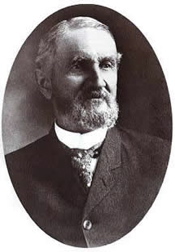
 He persuaded one reluctant Horace Bixby to train him to be a pilot for a handsome fee of $500. The seasoned boatsman believed the only way to learn was to “get this entire river by heart.” Admittedly not a details man (otherwise he might have checked the Amazon departures schedule and never ended up in New Orleans at all), Clemens readily agreed, his romantic view of river life looming large. In Life on the Mississippi—which Josh Ritter has said greatly influenced the album The Animal Years—you can read how he was hilariously disabused of his presumptions about the easy, glamorous life of the pilot. And yet despite all the appalled raging and railing—by the demanding Bixby and the demoralized Twain—you do sense that he indeed got the river by heart, because even when disguised, that book (as far as I’ve read) is a love letter of sorts. If roles were reversed and Twain was musician, one likes to think of him penning a sweet, if ironic, tune for his muse the mighty Mississippi.
 stagecoach, walking the miles and miles of desert between mining towns, and scratching for silver that evokes
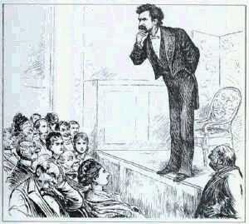 Made a splendid hit last night & am the ‘lion’ to-day. Awful rainy, sloppy night, but there were 1,200 people present . . . house
 Girl in the Gloaming