Again from his brumal sleep: Josh Ritter’s Wolves

It’s the dead of winter, and if not dead, sometimes it feels like the world’s asleep. We’ve had a lot of snow: gorgeous first-night wonderlands give way to majestic snowdrifts that gradually blacken and decay to reveal fossilized trash. We’re used to suiting up to go anywhere now, but we’re tired. Plans get broken, errands fall off the list, we want to be home. Or we just don’t want to be out. We’re—ok, I’m—restless.

There’s a huge, lone Christmas tree in the center of the tundra that is the square, in the shadow of a famous church. It’s strung with white lights, and when illuminated one can see that it’s listing. Tipping right over, as though trying to lay down for a nap. I will it to hang on as I hurry by.

[L]ate at night I like to imagine that they are killing: that another deer has gone down in a tangle of legs, tackled in deep snow; and that, once again, the wolves are feeding. That they have saved themselves, once again. That the deer or moose calf, or young dumb elk is still warm (steam rising from the belly as that part which contains the entrails is opened first), is now dead, or dying.

They eat everything, when they kill, even the snow that soaks up the blood. (NW, 3)

It’s a fine time to talk about winter-loving wolves, who are often photographed with a snowy backdrop. Their muzzles attract the flakes a little like cake crumbs, I’ve thought, which can make them look—for a fleeting moment—silly. But then there’s the pictures where teeth or nose have been dipped in a telling red, and I remember what they are. What they do. They love winter because their big paws allow them to run over the surface of deep snow. The long slender legs of their prey—deer, elk—poke through, slowing them down.

The wintry weather is likely just another challenge of a hard existence wolves seem thrillingly and incredibly willing to embrace. Imagine if instead of closing a menu and announcing your choice, every meal meant risking a broken skull, broken ribs, getting kicked or trampled. Sifting and sorting tirelessly through a herd, looking for the weak link, locking in, running oneself to exhaustion, darting in from behind, eyes wide, biting down—

They don’t have thumbs. All they’ve got is teeth, long legs, and—I have to say this—great hearts. (NW, 3)

That quote and the one above is Rick Bass, the Montana resident and writer, taken from his 1992 book called The Ninemile Wolves. He’s tells a good story; he’s a great fan. But I’m getting ahead.

There’s an intriguing song called Wolves on Josh Ritter’s fine record The Animal Years. It’s about a guy having some trouble with wolves, possibly Canis lupus irremotus, roughly translated as “The Wolf Who Is Always Showing Up.” The wolves in the song show up in a big way, zeroing in on a tender scene. Going in for the kill, leaving the speaker with only a vivid, persistent memory.

Here’s how it goes:
.

.

I still remember that time when we were dancing
We were dancing to a song that I’d heard
Your face was simple and your hands were naked
I was singing without knowing the words
But I started listening to the wolves in the timber
Wolves in the timber at night
I heard their songs when I looked in the mirror
In the howls and the moons round my eyes
So long, so high

Then winter came and there was little left between us
Skin and bones of love won’t make a meal
I felt my eyes drifting over your shoulder
There were wolves at the edge of the field
But I still remember that time when we were dancing
We were dancing to a song that I’d heard
Your face was simple and your hands were naked
I was singing without knowing the words

So long, so high

Then one day I just woke up
And the wolves were all there
Wolves in the piano
Wolves underneath the stairs
Wolves inside the hinges
Circling round my door
At night inside the bedsprings
Clicking cross the floor
I don’t know how they found me
I’ll never know quite how
I still can’t believe they heard me
That I was howling out that loud

So long, so high

At times in the frozen nights I go roaming
In the bed you used to share with me
I wake in the fields with the cold and the lonesome
The moon’s the only face that I see
But I still remember that time when we were dancing
We were dancing to a song that I’d heard
Your face was simple and your hands were naked
I was singing without knowing the words

So long, so high

~Wolves by Josh Ritter
.

I love that blissful, impromptu-feeling opening image. A few muffled bars overcome the static and someone leaps up from the dinner table, darts across the kitchen, cranks up the volume on the stereo. Or a new CD—purchased for that one intriguing, unforgettable, unfamiliar track—is crowbarred open and a lover called in from another room to hear. Suddenly—before there’s time to pick up what we carry—there’s dancing, a few precious moments where face and hands are stripped clear . . . of resentment, burden, judgment, whatever. One enters a place where words can’t follow, and finds that actually, you don’t need them.

We know they’re coming, though. There’s that galloping drum beneath even the vocals of the first words. It beats an ancient song of pursuit; I see a furious spray of snow, the skidding tracks. He starts listening to another song, a howl so long, so high, and things go south with the girl. They’re starving by the second verse, the wolf pack massing at the border. Then he wakes up and the wolves are in the house—everywhere—and it’s curtains. It ends and he’s alone, lonely, telling us for the third time about that time when we were dancing.

I still remember, he keeps saying. I still remember, like a mantra. Does that memory haunt him or hold him fast—mercifully—to a thing that’s gone?

I first read this piece as metaphor for the end—the depredation—of a relationship. You do often see it coming—once glimpsed it can feel inexorable, like that drumbeat. The good times loom up with such temptation—you keep remembering, remembering, thinking you’ll get it back. Then comes the unavoidable end. You go down fighting, like the deer.

But there are other clues, the most telling that glance in the mirror, and the lines I still can’t believe they heard me / I was howling out that loud. In the last verse he wakes from a dream in a field, staring at the moon. Who—what—is he, exactly?

Are the wolves indeed coming to kill? Or are they coming to claim him?

.
.
Old longings nomadic leap

There’s a prominent American author who was a little obsessed with wolves. He printed them on his personal stationary and bookmarks, named his dog Brown Wolf and his house Wolf House. He referred to himself as Wolf and asked others to too, and he wrote, extensively, about wolves. I’ve read that he is the most widely read and translated American author in the world. I’m not sure how to corroborate this, but it could be. He published a beloved novel in 1903 that was commemorated in 2003 as America’s Greatest World Novel. Beloved—I have to say this—especially by my seventh-grade English teacher. I still remember the look in his eye when we read the story about the guy and the fire.

The man—the writer, the wolf lover—is Jack London. Do you know the story of Buck? The dog who, captured in California and enslaved as sled dog in the Yukon gold rush, answers The Call of the Wild.

That book begins with this brilliant poem called Atavism by John Myers O’Hara:

Old longings nomadic leap
Chafing at custom’s strain;
Again from its brumal sleep
Wakens the ferine strain.

Brumal is an archaic word meaning indicative of or occurring in winter, ferine a synonym for feral, ie having escaped domestication, wild.

It’s the story of Buck’s waking up to a stirring, primal call, the one of his ancestors. Like our speaker in Wolves, Buck falls in love, and it complicates things:

[Buck] was older than the days he had seen and the breaths he had drawn. He linked the past with the present, and the eternity behind him throbbed through him in a mighty rhythm to which he swayed as the tides and seasons swayed. He sat by John Thornton’s fire, a broad-breasted dog, white-fanged and long-furred; but behind him were the shades of all manner of dogs, half wolves and wild wolves, urgent and prompting, tasting the savor of the meat he ate, thirsting for the water he drank, scenting the wind with him, listening with him and telling him the sounds made by the wild life in the forest, dictating his moods, directing his actions, lying down to sleep with him when he lay down, and dreaming with him and beyond him and becoming themselves the stuff of his dreams.

So peremptorily did these shades beckon him, that each day mankind and the claims of mankind slipped farther from him. Deep in the forest a call was sounding, and as often as he heard this call, mysteriously thrilling and luring, he felt compelled to turn his back upon the fire and the beaten earth around it, and to plunge into the forest, and on and on, he knew not where or why; nor did he wonder where or why, the call sounding imperiously, deep in the forest. But as often as he gained the soft unbroken earth and the green shade, the love for John Thornton drew him back to the fire again. (CW, 65-66)

Buck dreams a lot of his ancestors hunting with our human ones. I like that Wolves uses sleep and dream too: the wolves show up on a day when the speaker just woke up, and at the end he wakes up—dreams of waking up?—beneath the moon in a field. As wolf or man? Not clear. That’s the thing: I think this song is about what happens when the purest forces act on us, how we do or don’t reconcile the calls that humans hear. On one level I do think the wolves come to claim him, that it’s not just fear he’s feeling when he’s looking over her shoulder—It’s thrill. I think the song’s about how we’re part wild—some more than others, perhaps—like the wolves. Like Buck.

The refrain So long, so high, So long, so high, it occurred to me, might capture a wry farewell (So long) to that blissful time (so high) that he keeps remembering. For I think that listening to our call sometimes leads to sacrifice of even the the happiest, most life-giving things. It’s the conundrum we live with; it’s why we break our own and each other’s hearts over and over. It could be why he’s alone in the end, having made a conscious or unconscious choice. He’s so lonesome, but I wonder: is he also the slightest bit relieved?

Too far, I hear you saying. You’re right, there’s no textual evidence for that. Still. If not relief, I wonder if he’s looking up at that moon, some part of him knowing it was never going to end up another way. As dear as that memory—that girl—is.

I still remember, he keeps saying, and I wonder whether it’s to tell us, or to keep reminding himself. That he’s capable, that it’s out there, that it could happen again.

I won’t tell you how it ends for Buck, other than to say it does so with a song. (And you were right, Mr. Versluis: It’s lovely. I’m sorry your great enthusiasm went to waste in a junior high classroom. We just couldn’t get it.)

We do a lot of diving beneath allegories to peek around metaphors only to try (and try) to pry the lid off symbols around here, so I might as well say I like pondering what sounds the call. I mean, it’s the wolves here, but it could be anything. In Wolves it’s a song (that I’d heard) that prompts the joyous, cozy opening scene, and also a song (in the timber) that ultimately lures him away. Seems fitting for a musician. Such is the double-edged nature of a calling—of passion—I think.

.
.
“I mean, it’s just—they like to move.” ~Biologist Mike Jimenez

It’s an interesting time to be learning about wolves. I read Rick Bass’ The Ninemile Wolves, published way back in 1992, when an important chapter of an ever-lengthening story was being written. The book follows the fate of a pack in the Ninemile Valley, located in northwestern Montana. They were the first known pack in Montana to try and settle outside protected national park territory. The hope back then was that they’d make it to Yellowstone.

Why weren’t they in Yellowstone already? Because we killed them all. Well, first we killed all the bison, which were an important source of prey for them, then as Bass has it, we “tam[ed] the dry rangelands of the West into dusty factories of meat.” (NW, 35) The wolves turned their attention to the livestock, we turned our attention on them—

The wolves preyed on the [livestock], without question, but ranchers and the government overreacted just a tad. Until very recently, the score stood at Cows, 99,200,000; Wolves, 0. (NW, 5)

—and from the 1930’s to the 1990’s there were no wolves left in not only Yellowstone, but the entire American West. I mean, we really got into it, with government-issued bounties and everything. Hunters brought in their ears as evidence of a kill. Whether you love or hate them, you’d have to admit it was horrible. In 1974 wolves were put on the Endangered Species List. And in 1995—three years after Bass’ book came out—fourteen Canadian wolves were reintroduced to Yellowstone, amidst controversy. You can follow that extraordinary story in the National Geographic film Wolves: A Legend Returns to Yellowstone.

The fate of wolves, and our ongoing relationship with them is a hot topic, as we say in my family. I said it’s an interesting time because the twisting tale is about to get another chapter: the federal government seems to be on the brink of removing wolves from the Endangered List. It could happen this month. If it does, states will take control, free to set individual hunting seasons. Idaho, Montana, and Wyoming seem keen to do so. If the wolf population drops below a certain threshold, they’ll go back on the List and be protected. Two weeks ago seven conservationist groups filed a lawsuit over the setting of the population threshold.

I don’t feel informed enough to enter the fray, but it’s quite tempting to share Bass’ enthusiasm after reading his book. My favorite part is when the pups are orphaned, and Mike Jimenez, U.S. Fish & Wildlife Service biologist, is working like a madman trying to save them without their knowing, howling to them in backyards, dragging in road-killed deer (wearing gloves to mask his scent), hunting deer when there is no road-kill, protecting the meat from bears, propping dead deer up against trees in a running position to try and teach the pups how to hunt.

I won’t tell you the fate of the Ninemile—Bass will, in the 2003 Preface—or that first pack from the Yellowstone reintroduction, other than to say wolves seem to favor surprise endings, which I rather love.

They’re also fiercely territorial, hierarchical, family-oriented:

[W]olves are not about individuals, or green eyes, or howls, or big feet, or the kill. The story of wolves is about packs, about societies. (NW, 127-128)

And perhaps most important, they roam:

[T]raveling, and movement, seems to feed the wolf’s soul, as well: it’s nothing for them to cover twenty miles overnight on a hunt. (NW, 13)

Only one pair—the alpha male and female—in the pack mates each year. If a wolf is particularly aggressive or ambitious or feeling like an outcast—or hearing a call, I like to imagine— it will disperse. They roam, sometimes huge distances, looking for each other. For a mate. Bass spots lone wolves from his Montana window and is moved by their lonesome demeanor. If the disperser finds a mate, the pair roams some more to find an unoccupied territory. If they find one and mate, they’ll likely do like other wolves, and take an extra extra long ramble before the birth in the spring. According to the National Geographic film, all wolves—aunts, uncles, siblings—love and take part in the raising of puppies.

I wonder what it is to be so hard-wired for the pack, the society, and yet heed the call to disperse. I think about the speaker in Wolves. I think—I worry—about me, sitting at a desk day after day, looking into this screen. It’s not just the males that disperse; females do too.

I think about singing without knowing the words, how those inexplicable times really do imprint on our memory, how we call on them over and over, even after we’ve left them behind.

Forever trying to remember the time we forgot:

There is an ecstasy that marks the summit of life, and beyond which life cannot rise. And such is the paradox of living, this ecstasy comes when one is most alive, and it comes as a complete forgetfulness that one is alive. This ecstasy, this forgetfulness of living, comes to the artist, caught up and out of himself in a sheet of flame; it comes to the soldier, war-mad on a stricken field and refusing quarter; and it came to Buck, leading the pack, sounding the old wolf cry . . . He was sounding the deeps of his nature, and of the parts of his nature that were deeper than he . . . (CW, 39)

.
.
joshritterwolves1.jpg
.
..
..
..
..
Sources.
The Call of the Wild
by Jack London

The Ninemile Wolves by Rick Bass

Wolves: A Legend Returns to Yellowstone (DVD)

“Where I’m Calling From” by Ray Carver (Short story)

..
The Debate
The Grey Wolf according to the U.S. Fish & Wildlife Service. Best quote:

Biologists have identified a few of the reasons that wolves howl. First, they like to howl. . . .

Fear dominates wolf delisting debate (Plenty, Jan. 31, 2008)

Rocky Mountain wolf killing rule goes to court (Environment News Service, Jan. 28, 2008)
General George and me

I went to California for a meeting in early January and I got sick. And then I stayed sick. All that banging on about finding one’s voice in my last post and I got this virus going around that attacks the voice box. So I lost my voice for awhile there, and while that went on along came a “secondary infection” to perch on the viral one I already had. So January was a bit of a bust.

I did watch a movie about Irish rock music. I learned more about the showbands from my last post on Josh Ritter’s song Monster Ballads. Some revising was in order, some rethinking and quite a bit of rewriting. It’s done and I feel better. See the sections on the showbands, chorus, and last verse if you’re interested.

You’re likely not interested.

Recently I casually mentioned my Katy-the-train Monster Ballads theory to a friend and fellow fan.

“Really?” She paused, and then shrugged. “I guess I thought Katy was just a girl.”

“Maybe she is,” I sighed, and we laughed.

Maybe she is.

What can I say—I enjoyed the journey. I wanted it to feel right—right for me, not capital-R Right. The song kept changing before my eyes, changing with me through time. There’s just enough to entice and elude you, the perfect balance. You hear what you want or need to hear. I realize that. I love that. And I bet you I’ll change my mind all over again someday.

But for now I’m working on something new. No steamboats, no Mississippi River, no Twain. No Katy. I thought I’d put a deadline up in lights, say February 12?

‘Til then.

.
.
day2.jpg
.
.
day3.jpg
.
.
day4.jpg

Desert radio: Monster Ballads revisited

Well, I said we should be ready to change our minds. I said anyone who could see how wrong we’ve been should be convinced of that.

Turns out I was wrong. Well, I suppose we don’t get to know, but I’m saying I was wrong. I’ve come up with something I like better. Even if it’s rather strange.

I’m talking about my interpretation of Josh Ritter’s song Monster Ballads off the album The Animal Years. It’s been a revelatory week around here, all put in motion by one insightful reader. All put in motion by one little four-letter word.

To recap where we are:

I wrote a post called “Complicated unities” about the cryptic and beloved song Monster Ballads in early October. I’m not going to link to it here because you shouldn’t read it if you haven’t already. Not yet, anyway.

A week ago ritterwriter stopped by and left a commentit’s upin which she politely took issue with some of my points. When I read her thoughts I knew she was on a very good track. As I pondered it I suddenly saw a new meaning for the fateful word around which much of my former analysis had turned . . .

And that correction of course set off another extraordinary journey. From the Mississippi River and the mining camps of the Nevada Territory in one century . . . to a sweaty wayside dance hall in Ireland in the next . . . to a wandering, worried, wondering soul hurtling down a ribboned desert highway in the one after that. Do you have the strength? I barely did. But here we go.

[<< REWIND.] Track 3. Play.

First verse.

Radio waves are coming miles and miles
Bringing only empty boats
Whatever feeling they had when they sailed
Somehow slipped out between the notes

A ghostly, mysterious, foreboding image. Empty boats summoned by radio waves, drifting aimlessly, robbed of feeling, purpose, passion. It slipped out between the . . . notes? They can’t be only boats. I don’t think anything is one thing only is this song, let’s be clear. Let’s see, there’s radio . . . and notes. Music.

Next is the chorus, which we’ll get to:

Out on the desert now and feeling lost
The bonnet wears a wire albatross
Monster ballads and the stations of the cross
Sighing just a little bit, Sighing just a little bit

. . . But first we need the second verse and some history for some important clues.

Second verse.

And I was thinking ’bout what Katy done
Thinking ’bout what Katy did
The fairest daughter of the Pharaoh’s son
Dressed in gold ‘neath pyramids

.
Steamboats

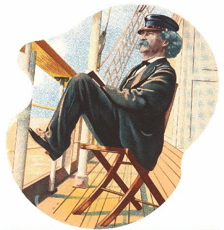
In 1858, as the Civil War loomed, the man who would later be widely recognized as America’s greatest writer was at work learning every bend of the Mississippi River. Samuel Clemens (who became Mark Twain), twenty-two years old, was nearing completion of his steamboat pilot apprenticeship and eagerly awaiting the day he could collect the licensed pilot’s handsome salary of $250 a month. He’d always known the river: he’d passed his boyhood in the port city of Hannibal, Missouri, where every boy’s most fervent and enduring wish was to be a steamboatman, and each day was brought to life and then left for dead with the arrival and departure of the daily packet from St. Louis. Piloting a riverboat was a dream come true.

August of 1858 also marked an historic event: the very first transatlantic telegram was sent via under-the-sea cable from Queen Victoria to President Buchanan. Twain, ever enthused by new technology, later recalled, “[a] wave of jubilation and astonishment . . . swept the planet.” (MTE, 10) Passengers would have had lots of company if they wanted to discuss the exciting news: the heavily freighted steamboats navigated a crowded river. They were enjoying the final of their glory days.

The outbreak of the Civil War ended Twain’s pilot career, but it was the greatest source of nostalgia throughout his extraordinary life. In his middle and old age he longed for the river, saying if given the chance to live his life over he’d never leave it. In letters he reminisced about the hot rolls served at supper, the fragrant coffee coming through the pilot house door on a steward’s tray, the red-faced, sweating, swearing first mate and the tumbling deck hands, the bells that clanged through one’s slumber.

With the invention of wireless telegraphy, or radio, at the end of the nineteenth century, boats gained a way to communicate with each other and those on shore. But once radio operators had begun traveling on ships—in the early 1900s—the Mississippi was a far different place than it was when Samuel Clemens was a cub pilot. Boats had vanished from the levees, once-bustling passenger decks were empty. Twain himself accepted this mournful truth back in 1882, when he famously returned to research his book Life on the Mississippi. He wrote

Half a dozen sound-asleep steamboats where I used to see a solid mile of wide-awake ones! This was melancholy, this was woful. The absence of the pervading and jocund steamboatman from the billiard room was explained. He was absent because he is no more. His occupation is gone . . . Here was desolation, indeed. (LM, 172)

What was to blame?

Steam Locomotive

As Twain writes [emphasis mine]:

The towboat and the railroad had done their work, and done it well and completely. The mighty bridge, stretching along over our heads, had done its share in the slaughter and spoliation. . . .

. . . Mississippi steamboating was born about 1812; at the end of thirty years, it had grown to mighty proportions; and in less than thirty more, it was dead! A strangely short life for so majestic a creature. (LM, 173)

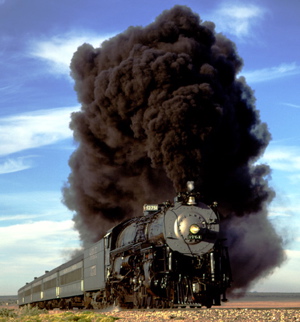
One particular railroad began a historic service to open up the remote Indian Territory to and through Texas when the Missouri-Kansas-Texas Railroad, known as the MKT, or Katy, was christened in 1870. Railroad fever was everywhere—there was a race on to offer transcontinental service, and the evolving feasibility of western migration fired imaginations. In 1873 the Katy acquired the Hannibal & Central Missouri Railroad, which had been leased previously by another company that serviced the track from Hannibal through Illinois, Indiana, and Ohio. Katy supervised the traffic on these tracks until 1897.

The fairest daughter of the Pharaoh’s son
Dressed in gold ‘neath pyramids

Egypt. A descendant of . . . Moses? Well, Katy did set off into the unknown, lending a hand in leading a young America into what it considered (albeit unfairly) a promised land of sorts.

And she went east out of Hannibal too, leading her passengers through a sluicing sea . . .
.

Mark Twain Memorial Bridge

.
The bridge in the foreground is the Mark Twain Memorial Bridge, built over the Mississippi in 2000. The harbinger of slaughter and spoliation behind it—half a mile away—is the Wabash Bridge, built for the railroad in Twain’s hometown of Hannibal, Missouri, in 1871.

And pyramids . . . indeed.

Showbands
(Bear with me here.)

In the 1950s, one hundred years after the majestic steamboats ruled the Mississippi, the stage was being set for a musical phenomenon to sweep the dance halls and ballrooms of Ireland. It’d be an act never replicated in any other country, likely helped along by the media vacuum that existed on the island. It’d be how future stars like Van Morrison and Rory Gallagher would get their start. They’d have names like The Clipper Carlton and The Royal. They were showbands, formed through the combined influences of 1) big bands and orchestras, which were more prevalent in urban areas and performers of popular hits of the day and 2) céilí (pronounced “kay-lee”) bands, which performed native Celtic music.

Their venues were often simple barn-like structures on the outskirts of town, destinations often reached by carpool or bicycle. The Catholic Church’s strong hold over social customs propelled the dance halls and ballrooms to a crucial status in town and village life; they were the most popular place for people to meet. Men stood on one side, women on the other, waiting for an invitation to dance. In his 1972 short story The Ballroom of Romance, William Trevor writes this about a night at the fictitious eponymous hall:

Dust and cigarette smoke formed a haze beneath the crystal bowl, feet thudded, girls shrieked and laughed, some of them dancing together for want of a male partner. The music was loud, the musicians had taken off their jackets. Vigorously they played a number of tunes from State Fair and then, more romantically, ‘Just One of Those Things.’

The showband era is a cherished and nostalgic one for many, but one wouldn’t want to suggest raising a glass to the showbands if she were to bump into, say, Bono in the pub. The rock music documentary Out of Ireland (distributed as From a Whisper to a Scream in the UK) disposes of the showbands in a handful of minutes after the opening credits, but not before a series of rockers and other industry luminaries try to do outdo one another with their insults.

Bono says this

Showband music was just—It was the enemy.

Criticism stems from the bands’ lack of creativity and innovation, for in their prime the showbands mostly covered popular hits of the day—often American ones. Irish musician and activist Bob Geldorf charges the showbands merely with arresting any and all progress in Irish music during their reign, praising his countrymen for the gymnastics required to overcome the disaster:

Socially the showbands were important. Musically, and every other which way, they were a death, which is why contemporary Irish music took so long to develop. And it came out of the Irish tradition, vaulting over the years of desert—the desert years of the showbands. It vaulted over because it’s a strong, true music.

So, the showbands were “an appalling travesty,” Geldorf concludes. (Did he just say desert?) And just to drive home a delicate point—

The showbands were CRAP!

They were at their height in the early-to-mid ’60s, just as Ireland began opening up to the rest of the world. The RTÉ One television station was founded. The Beatles arrived and the music industry took a jolt. People began to buy records. In 1962, The Royal recorded the very first showband single, a cover of an American bluegrass standard penned in the same year. Tom Dunphy sang the vocals.

Know what it was?

Come Down the Mountain Katy Daly
.

katydaly_record240width.jpg katydaly_recordsleeve1.jpg

[photos credit: www.irish-showbands.com]

The record sleeve above doesn’t mention The Royal Showband, but you’ll find it on this page dedicated to that band on the enthusiastic and rather fabulous irish-showbands website. I know the spelling is Katie, but you’ll see that Katy was the original spelling, and that’s how it’s listed on the showbands website.

And I was thinking ’bout what Katy done
Thinking ’bout what Katy did
The fairest daughter of the Pharaoh’s son
Dressed in gold ‘neath pyramids

See this discussion for the lyrics (and information about the spellings and origin) of Katy Daly. The words do conjure an image of Moses (ie daughter of the Pharaoh’s son). Come down the mountain, a “judge” sentencing her. Next time you’re in Belfast, you could have a drink here.

I know this whole line of investigation may sound mad but at its heart is this: while we follow Mark Twain in his journey in Monster Ballads, I think we follow someone in this century too. While the train Katy was responsible for weakening Twain’s beloved steamboats, and is therefore a touch point for nostalgia and loss and longing, I wonder if Katy the record may be a symbol for something about the showband era that may have a relevance today.

So what could Katy the record have done? Could she have kicked the showbands off the circuit, like the trains did the steamboats on the river? To be honest I don’t know anything about that particular recording by The Royal Showband. But the advent of records and radio and television in Ireland did not help the showbands thrive:

From the mid-1960s exposure [in Ireland] increased, especially in urban centres, to newer forms of rock and pop music, performed by original artists. This was due to access to British television and radio stations, pirate radio, and new record shops catering to these tastes. Young people increasingly saw showbands as old-fashioned and rustic.

Maybe Katy, as symbol for copycat music, held up the condemning mirror that would end the drought of originality in Irish music. And as Bob Geldorf explains, Irish rock music would heed the call, finding its voice despite the showbands. In a moment I’ll talk more about the notion of voice in this song.

But before we go on I think it’s only fair to add that the film Out of Ireland has wonderful footage of showband performances that captures packed ballrooms of smiling, jostling, shoulder-to-shoulder patrons, ready to dance. Quite simply, it seems showbands knew how to perform, how to entertain. How to provide an opportunity to escape, and connect. Everyone can at least agree they had a significant social influence. Mentions of showbands are often accompanied by just how many people they touched: the huge and regular audiences, the explosion of constantly-touring bands. Their hallmark was passion, perhaps their major contribution to history rebelling against the more dignified disposition of the big bands. I wasn’t there, I’m no music history expert, but from what I’ve seen and read, it all seems quite—honest.

And it all reminds me—the passion and joy and professionalism and suits and squeaky-clean smiles—(just a little) of some wonderful concerts I’ve seen by a singer-songwriter (or rocker, or front man, or whatever he’s going by) that I rather like.

So there’s a little part of me that doesn’t want this (albeit precarious) connection to the showbands to be entirely critical. I wonder about the parallel of then and now with regard to isolation, the need to connect with one another, and the change brought about by the media. In the next section I’ll explain my thoughts on commentary about the digital age in this song. I love that the showbands put on such a grand, interactive show, and going to see them was, for a certain time in a certain place, woven into the fabric of everyday life. I wish I could go just once, whatever Bono says. Actually I wish we all went more often, like they did back then.

And as long as we’re in Ireland and talking about radio and performance, I’ve got one more thought on the identity of Katy. You know her, that girl famously declared the Northern Lights. She was a big hit in Ireland, as far as I understand, on the radio and everything. She’s a showstopper if you go see Josh Ritter live. I don’t know much about his early career, but it seems like the song Kathleen has done some very good things.

Whatever or whoever she is, Katy’s dressed in gold ‘neath pyramids. Note the showband record sleeve above is gold.

And would you humor me all the way here:

.
rockandrollhalloffame500width.jpg

.
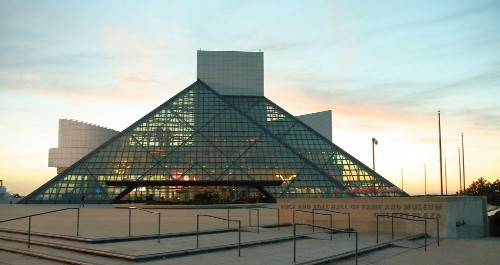
That’s the Rock and Roll Hall of Fame, located in Cleveland, Ohio. They’ve got an exhibit called The Roots of Rock that has a section called Country/Folk/Bluegrass. They’ve also got an exhibit called Hang on Sloopy: The Music of Ohio. Remember Katy Daly is an American bluegrass standard, and know the man who wrote it, Paul “Moon” Mullins, was recently honored for his long-standing radio career in Ohio.

I suspect they’ve got lots of records theregold, platinum, the lot.

And pyramids.

Chorus & bridge.

Out on the desert now and feeling lost
The bonnet wears a wire albatross
Monster ballads and the stations of the cross
Sighing just a little bit, Sighing just a little bit

Ones and zeros bleeding mesa noise
And when you’re empty there’s so much space for them
You turn it off but then a still small voice
Comes in blazing from some vast horizon

I am still inclined to find a meaning for Sam Clemens here. He ended up out on the desert after he left the Mississippi River in 1861. He traveled west in a Concord stagecoach (in which the bonnet wore a wire albatross?) with his incredibly straight-laced brother, Orion, who had employment in the Nevada Territory. Sam didn’t have employment, and he didn’t want it. But he was by no means free of ambition, or pressure:

But of two things [Clemens] was certain. One: he had no intention of following one of the usual professions, such as law. . . . Two: he was not going home until he was rich, even if that took more than three months. Fortunes were to be made. He wanted one. And the eyes of the homefolk were on him. He would not return without the wealth that would prove him estimable in their eyes. (SMK, 93-4)

Silver had been discovered in nearby Virginia City in 1859, and an excited and optimistic Clemens flew headlong into the mining business, investing the modest capital he had and traveling long distances between mining towns:

[For the first three months of 1862] his mind was almost entirely on ledges, ledges in Humbolt, Virginia City, and Aurora: how many feet could be bought at what price with what promise of return. (SMK, 95)

Ones, zeros, dollar signs flooding his thoughts from the mountains, the mesas, the desert. He didn’t strike silver or gold. Instead he got homesick, exhausted, frustrated, blistered and broke. And feeling lost, presumably. While mining he’d somehow found time to write and send in two letters using the curious pen name “Josh” (yep) to a local newspaper, and he finally gave up and in and reported—dusty and disheveled—to the Virginia City Territorial Enterprise in September 1862. Staff writer. Though the banality of daily local news left him uninspired, nineteenth century journalism allowed for the blurring of fiction and non-fiction, seriousness and satire.

Clemens seized that opportunity, and into the lines of the goings-on in a rather wild frontier town, a voice—small, for now—began to settle into a register. In February 1863 he woke up after a late-night party and signed his first article Mark Twain. That year he poked fun at himself (though he had certainly not sworn off investing or hoping for return) by announcing to his increasingly amused readers that he’d founded the “Unreliable, Auriferous, Argentiferous, Metaliferous Mining Company.” (L1, 252)

But he was not free from hardship: it followed him to San Francisco, where he was fired from a journalism job and spent some months “dead broke,” clinging to one desperate dime to avoid destitution. He later spoke vaguely of a suicide attempt. When his buddy Steve Gillis got into a barroom fight, Twain posted $500 bail. The police soon came for Gills, and both men fled town. They ended up in a rustic bachelor-pad cabin in the middle of the Sierra foothills where “hygiene and cuisine were minimal.” (SMK, 129). The men lazily panned for gold by day. Twain did too, but he was no longer convinced of or obsessed with his ability to strike it rich.

Instead he began keeping a regular journal that bore the unmistakable markings of the writer’s notebook. The biographer Fred Kaplan says this happened on Jackass Hill:

For the first time . . . Twain’s observations were tempered by and mediated through a literary self-consciousness, a sense of self that he had not had before. (SMK, 128)

Twain first heard and sketched a very important story for his career in that cabin. My favorite image is that of him laughing to himself as he wrote by firelight—quiet and calm and free of the urge to join the others outside digging for gold—a funny story about a jumping frog that would introduce a border ruffian to readers on the East Coast. Despite what happened to Michael Lewis, someday I’d like to visit Mark Twain on Jackass Hill.

But back to the twenty-first century.

Out on the desert now and feeling lost
The bonnet wears a wire albatross
Monster ballads and the stations of the cross
Sighing just a little bit, Sighing just a little bit

Ones and zeros bleeding mesa noise
And when you’re empty there’s so much space for them
You turn it off but then a still small voice
Comes in blazing from some vast horizon

Someone is lost, sighing, empty—echoing the empty boats in the first verse. Turn off the noise and in blazes a still small voice.

Bonnet, if you take the UK meaning—automobile hood—places one in the car. Perhaps the wire albatross—which can be defined as something burdensome— related to the radio. My last interpretation of Monster ballads and the stations of the cross relied heavily on a biblical meaning; lately it feels a little like a red herring. Perhaps it’s all he can find on the radio of his car—there are organ pieces called Stations of the Cross. (In September I’m afraid I even bought this CD. Perhaps I’ll do a giveaway.) Ballad is a loaded word in the history of music and radio. I like the idea of stations of the cross referring to the notion that station is a word meaningful for both radio and train.

And I do hear a meaning for Twain: his days out west were wild (monster ballads), his courtship of a devout heiress (and future wife) marked by fervent spiritual awakening (stations of the cross). He’d be lost and found all over that map in his life.

Mesa is where I think I went slightly wrong last time. I read it as being the manufacturer of guitar amps of the same name. I know, it doesn’t sound likely, but I read that mysterious refrain Monster ballads and the stations of the cross as being two extremes, as an either-or choice. The mesa noise paired with the Monster ballads songs—it seemed acceptable to link hard rock with noise—and the still small voice with stations of the cross.

But then, as I’ve said, a clever reader left a comment saying this

In the context of 1 Kings 19:11-12, I picture computers and televisions and cellphones and all other digital noise (ones and zeros) as the great, flashy, sometimes destructive forces that seem so important (the wind, the earthquake, the fire), and the ringing silence when all that is shut out as the still small voice, the truly essential and beautiful element of faith, music, life.

And suddenly I saw this

00000000000000000000000111111111111111110000000000000000000000000
00000000000000000000000111111111111111110000000000000000000000000
00000000000000000000011111111111111111111100000000000000000000000
00000000000000000001111111111111111111111111000000000000000000000
00000000000000000111111111111111111111111111110000000000000000000
00000000000000011111111111111111111111111111111100000000000000000
00000000000001111111111111111111111111111111111111000000000000000
00000000000111111111111111111111111111111111111111110000000000000
00000000011111111111111111111111111111111111111111111100000000000
00000001111111111111111111111111111111111111111111111111000000000
00000111111111111111111111111111111111111111111111111111110000000

And I thought, Huh. A mesa. And then I thought . . . Duh.

Given this piece I’m going to go with mesa noise referring to the radio, and by extension, music. Here’s a simple explanation of how digital radio works. And, while God is indeed (and often) somewhere, I’m going to favor the still small voice as referring first to that of the creative spirit of the conflicted or searching or embattled—show me one who isn’t—artist.

So.

So.

That’s my best guess at what it all means, but of course that still leaves what it all means.

Today, for me, in light of the above . . . I think the words and images and dual narratives go to the heart of the artistic journey: to the sacrifices, the challenges, the doubt, the resilience required (and the magic that can happen) when the river gets pulled out from underneath you, or it feels like nobody’s noticing. It’s likely this song turns a critical eye on the music that’s getting played on the radio. Those empty boats in the first verse could be songs.

The refrain of being out on the desert now and feeling lost makes me think of this quote in which Josh Ritter talks about the selection of the album name The Animal Years:

I was thinking back on the period of my life leading up to this record and my experience up to that point was, you get up, you start to play music and you tour. It’s such a strange life style. In a lot of ways I felt like I became this thing, half-man, half-animal, out in the middle of the country, playing. It was so bizarre. Everyone else is living their lives and doing things that are a bit more normal. Man, after a year and a half on the road, 16 months of touring for Hello Starling, I became the proto-hunter-gatherer, going out wherever and doing stuff and trying to find a way to make sense in a human way. But, really, in the end, you’re just trying to get food in your mouth. I think back on that time and feel definitely, those were my animal years.

And here’s what he had to say when he stopped off at the Rock and Roll Hall of Fame while on tour for his newest album in October 2007:

The real rock halls of fame are the venues that hundreds of bands pass through each year. These places, from community halls to old vaudeville theaters to tetanus traps in big and small towns across the world are where the real histories are made. These are the places where the house sound guy is cranky, the bartenders come in early and manage to work through hundreds of soundchecks, where guest lists and attendance numbers are haggled over, where posters are hung and taken down and hung again and where people – strangers – come and hang out with each other to listen to music played in the moment by other people. I think these kinds of halls are great enough.

from Nebraska Rock and Roll by Josh Ritter (posted 10/17/2007)
[Check out the picture he posted from the museum.]

I hear a shadow of these sentiments in Monster Ballads. I think about those Irish showbands and the joy of live music and the irony of isolation in this new digital age.

Lastly, for me, this song is certainly about the triumph and perseverance of passion. For that we need the last verse.

Third verse.

And I was thinking ’bout my river days
Thinking ’bout me and Jim
Passing Cairo on a getaway
With every steamboat like a hymn

I forgot to tell you one thing about the steamboats and the showbands, something about that organ we hear in verse 1 and 2 of Monster Ballads. Some steamboats (often called, er, showboats) had a calliope, or steam organ, with which to entertain passengers. You can hear a calliope here. And the showbands, they replaced the pianos reminiscent of the big bands with . . . an organ.

The stripped-down instrumentation of this quiet and exceptionally beautiful last verse gives us pause. We lean in and listen. It is poignant that there is no organ; I think that’s a clue. I wonder about a subtle connection to this song, released in 1963 by The Kingston Trio.

And as for Huck Finn, the narrator of this final verse . . . or is he? Could it be Twain himself? Do you know what Mark Twain did when he got back from that historic and revelatory reunion with his beloved Mississippi? From looking in vain for the steamboats crammed like sardines at the wharf, from saying this about his old friends:

[I can] call their names & see their faces, now: but two decades have done their work upon them, & half are dead, the rest scattered, & the boat’s bones rotting five fathoms deep in Madrid’s Bend. (SMK, 382)

Well, upon Twain’s return home he slogged through the grueling composition of Life on the Mississippi. He hated writing it. After he finished he turned to a manuscript he’d begun all the way back in 1876. And suddenly he was granted a “literary cakewalk,” flying high through the ecstatic completion of The Adventures of Huckleberry Finn. (SMK, 393)

He successfully—brilliantly—enlivened the river of his boyhood, no matter what had happened to it since. His work—his voice—enabled him to get back and share what he loved so well.

I think that’s one way of trading this

Sighing just a little bit

for this

Smiling just a little bit

As for Huck Finn—just for one last leap—here he is talking about me and Jim:

It’s lovely to live on a raft. We had the sky, up there, all speckled with stars, and we used to lay on our backs and look up at them, and discuss about whether they was made, or only just happened—Jim he allowed they was made, but I allowed they happened; I judged it would have took too long to make so many. Jim said the moon could a laid them; well, that looked kind of reasonable, so I didn’t say nothing against it, because I’ve seen a frog lay most as many, so of course it could be done. We used to watch the stars that fell, too, and see them stream down. Jim allowed they’d got spoiled and was hove out of the nest. (AHF, 179)

Just the other day I remembered a similar partnership:

Me and Jiggs staring at the ceiling the stars above the radar range

A railroad and a record, steamboats and showbands, Cairo and the county line. Katy, Twain, Huck, and Jim. Kathleen, Jiggs, and Josh. Maybe some Irish music history. As my sister says, That’s all I got. I leave it up to you.

But back to Twain’s deserted river one last time:

[I]f Twain hoped to hear his name sung on the river, he was disappointed. [He wrote,] “They do not call in the singing tone at the heaving of the lead as they used to, nor do they sing when leaving port.” (SMK, 386)

This fall Josh Ritter took his show and his extraordinary band on the road. Monster Ballads got slightly rearranged, but it still did every bit what I like to think Josh wrote it to.

We came in off our deserts—streamed in from our tiny cities made of ashes—and took out our ear buds and powered down our phones and held high our cameras and chose for one night a different noise in the theatres and clubs and halls and rooms. A cultural center, a playhouse, a ballroom, showbox, academy, and cafe. From cradle to empire.

Josh thanked us repeatedly for coming, of course.

And we did for him what they didn’t for Twain. We sang our hearts out.

.

joshrritterroyal.jpg

.

. .
.

[Postscript]

One does not leap to these sorts of wild conclusions overnight.

If you’re dubious about Twain connections in the album The Animal Years, you may find my post Girl meets Mark Twain interesting.

To see what I had to say after I braved the 400+ pages of Twain’s Mississippi River fantasia . . . and missed (so close!) these Monster Ballads connections altogether, see Reading the Mississippi. There’s a Dr. Seuss mash-up!

Last June I got nostalgic thinking about the final verse of Monster Ballads while I was moving across town—that’s River days.

And to see my previous post on Monster Ballads, which I’m going to leave up, see Complicated unities. It tracks a telling journey and unwittingly illustrates some of the magic of the song.